What is buffered coco coir?
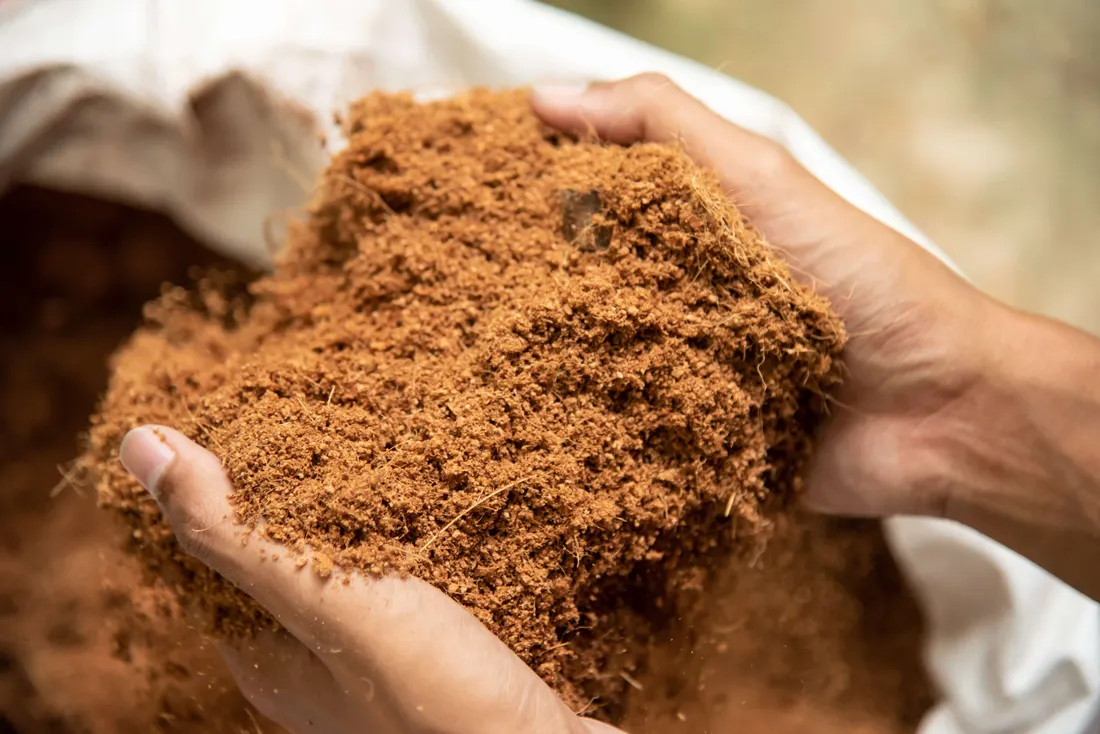
Buffered coco coir has already been soaked to wash out excess salts before it ever reaches you. Here is what that means, why it is done, and whether your garden actually needs it.
The short answer
Coco coir naturally holds on to salts. Buffering soaks them out and puts calcium and magnesium in their place, so the coir is not competing with your plants for the food you give them. It matters most for seeds and potting mixes, and hardly at all for mulch spread on the surface.
What buffering actually is
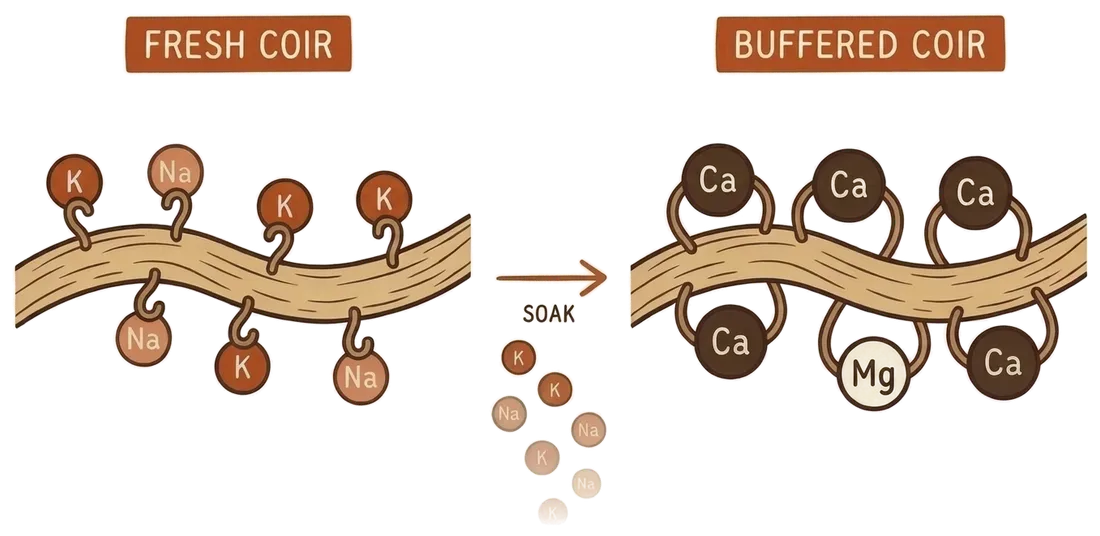
Picture coco coir as a sponge covered in tiny hooks. Those hooks are what let it hold on to water and to the minerals your plants feed on. They are a large part of why coir works so well in the first place.
Fresh from processing, though, the hooks are already full. They are holding salts: some from the coconut husk itself, and some picked up from the water used to soak and clean it. So when you feed your plants calcium and magnesium, the coir trades. It takes the calcium and magnesium you just added and lets go of the salts it was holding. Your plants end up with less of what you gave them and a dose of something you did not.
Buffering makes that trade happen on purpose, before the coir gets anywhere near your garden. The coir is soaked in a calcium and magnesium rich bath until the hooks are full of those instead, then the loosened salts are rinsed away. By the time you add water, there is nothing left for it to swap.
Do you actually need it?
Honestly, it depends on the job, and plenty of garden jobs do not need it at all. Here is where it matters, most to least.
- Starting seeds
- Potting mixes and containers
- Mixed into garden beds
- Spread as surface mulch
Starting seeds | Yes, this is where it matters most. Seedlings are the most sensitive thing in your garden to leftover salts, and they are fed very lightly, so anything the coir holds back gets noticed. |
|---|---|
Potting mixes and containers | Yes. In a pot, the coir is most of what the roots ever touch, so what it is holding on to matters. |
Mixed into garden beds | Less so. Your soil brings its own reserve of calcium and magnesium, which softens the effect considerably. |
Spread as surface mulch | No. Mulch sits on top of the soil rather than around the roots, so there is nothing for it to trade with. |
That last row is exactly why our Organic Mulch is not buffered. It is coconut husk chips meant for the surface, and buffering would not change a thing about how it works.
Advanced
Going deeper
That is the whole of it for most gardens. What follows is the same story with the actual chemistry and the actual numbers, for anyone who wants them.
Rinsed is not the same as buffered
These two words get used as though they mean the same thing. They do not, and it is the most consequential mix-up in the category.
Rinsing is dilution. Clean water carries off whatever salts are dissolved in the water sitting in the coir, and the EC drops. Buffering is ion exchange. A concentrated calcium solution displaces the potassium and sodium bound to the coir's exchange sites, and then those loosened ions get rinsed away.
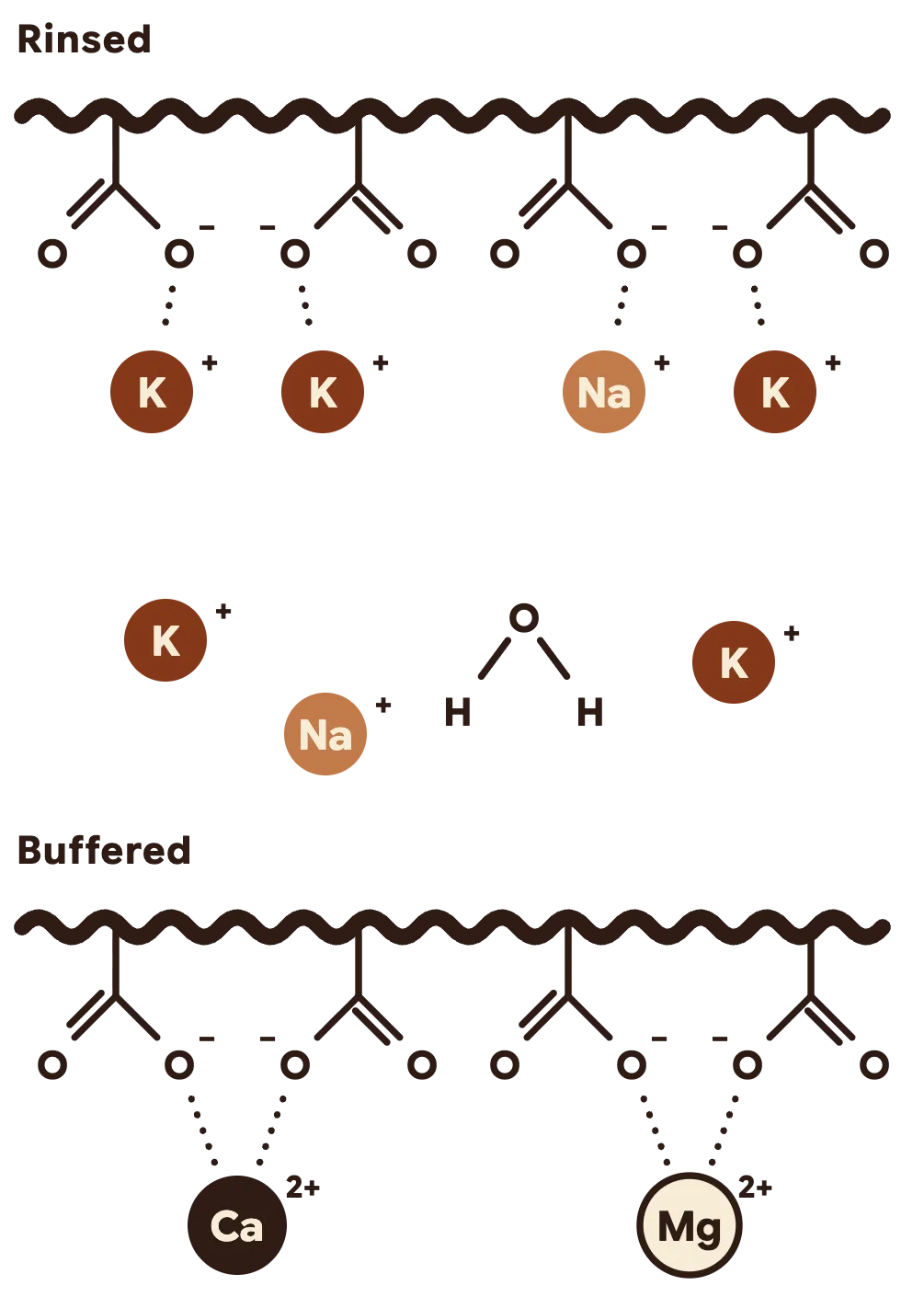
The consequence is the part worth remembering. EC measures what is dissolved in solution. Exchange-site loading is a different measurement entirely. Water is a poor exchanger because it supplies no competing cations to knock the bound ions loose, so coir can be rinsed until the runoff reads low and still have exchange sites saturated with potassium. Rinsing coco coir with water will not by itself alter its exchange capacity.
One vendor's before-and-after figures illustrate the gap. Washed but unbuffered coir measured 0.8 mS/cm while still carrying 152 ppm potassium. After buffering, potassium fell to roughly 16 ppm while the EC barely moved. Treat those particular numbers with caution, since it is a single source with no published method and the sodium result hardly shifted, which is odd for a process meant to displace it. The shape of the result is the useful part: the EC reading told you almost nothing about whether the coir had been buffered.
What is actually happening
Coir pith is lignocellulosic. Its particle surfaces carry a net negative charge from carboxyl and phenolic groups, and those negative sites attract and hold positively charged ions. The total count of them is the cation exchange capacity, or CEC.
How large is coir's CEC? Sources disagree considerably. The peer-reviewed figure from Abad and colleagues, measuring 13 samples in 2002, is 31.7 to 95.4 cmolc/kg. The number the trade usually repeats is 10 to 30 meq per 100 g. Those are the same unit, which puts the industry figure at roughly a third of the published one. Anyone quoting a single confident CEC number for coir is overstating what is actually settled.
Where the salts really come from
The usual story is that coconuts grow by the sea, so coir is full of sea salt. It is tidy, and it is not really right. The coconut palm is a heavy potassium accumulator, so the husk is potassium rich before anyone touches it. Abad's samples ran from 2.97 to 52.66 mol per cubic meter, which the paper describes as remarkably high. Sodium is the smaller part of the problem and is largely a processing artifact: husks are retted, meaning soaked to loosen the fiber, and the FAO's description of coir processing notes that green husks are commonly retted in brackish backwater for 10 to 12 months. Most of the sodium comes from the water, not from the tree.
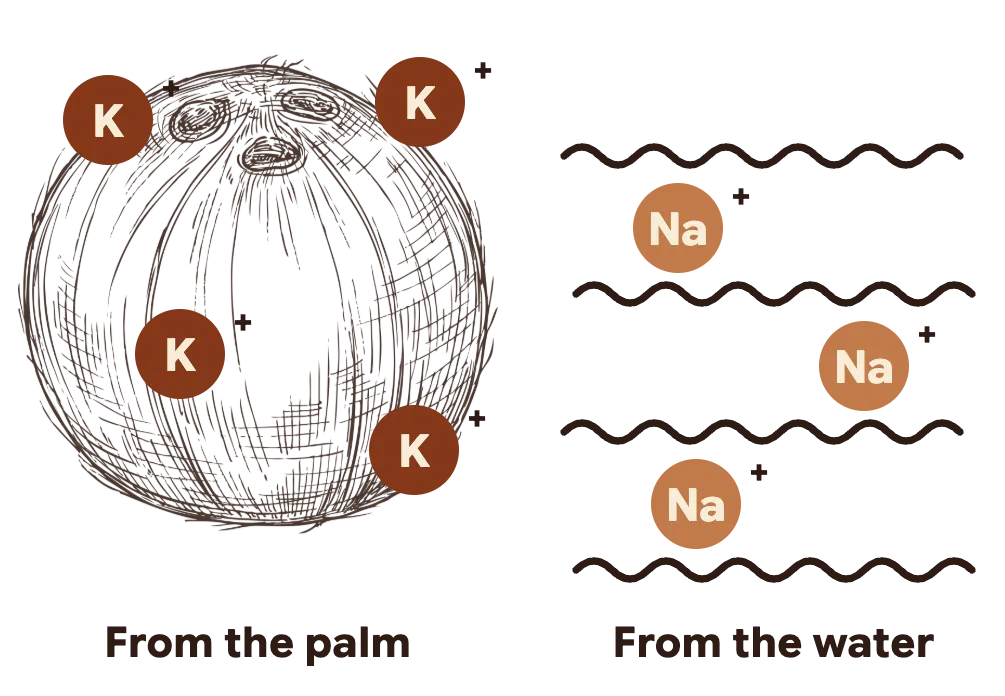
How full the sites are is contested too. RHP, the Dutch certification body, says the adsorption complex is roughly 75 percent occupied by potassium. Much of the trade quotes 40 percent potassium and 15 percent sodium instead. Take the range rather than either figure.
The exchange itself
Calcium and magnesium carry two positive charges. Potassium and sodium carry one. Divalent ions bind exchange sites more tightly than monovalent ones, and a concentrated solution adds mass action on top of that, so both forces push the same direction. Flood the coir with calcium and the calcium takes the sites while potassium and sodium go into solution. Rinse, and they leave with the water.
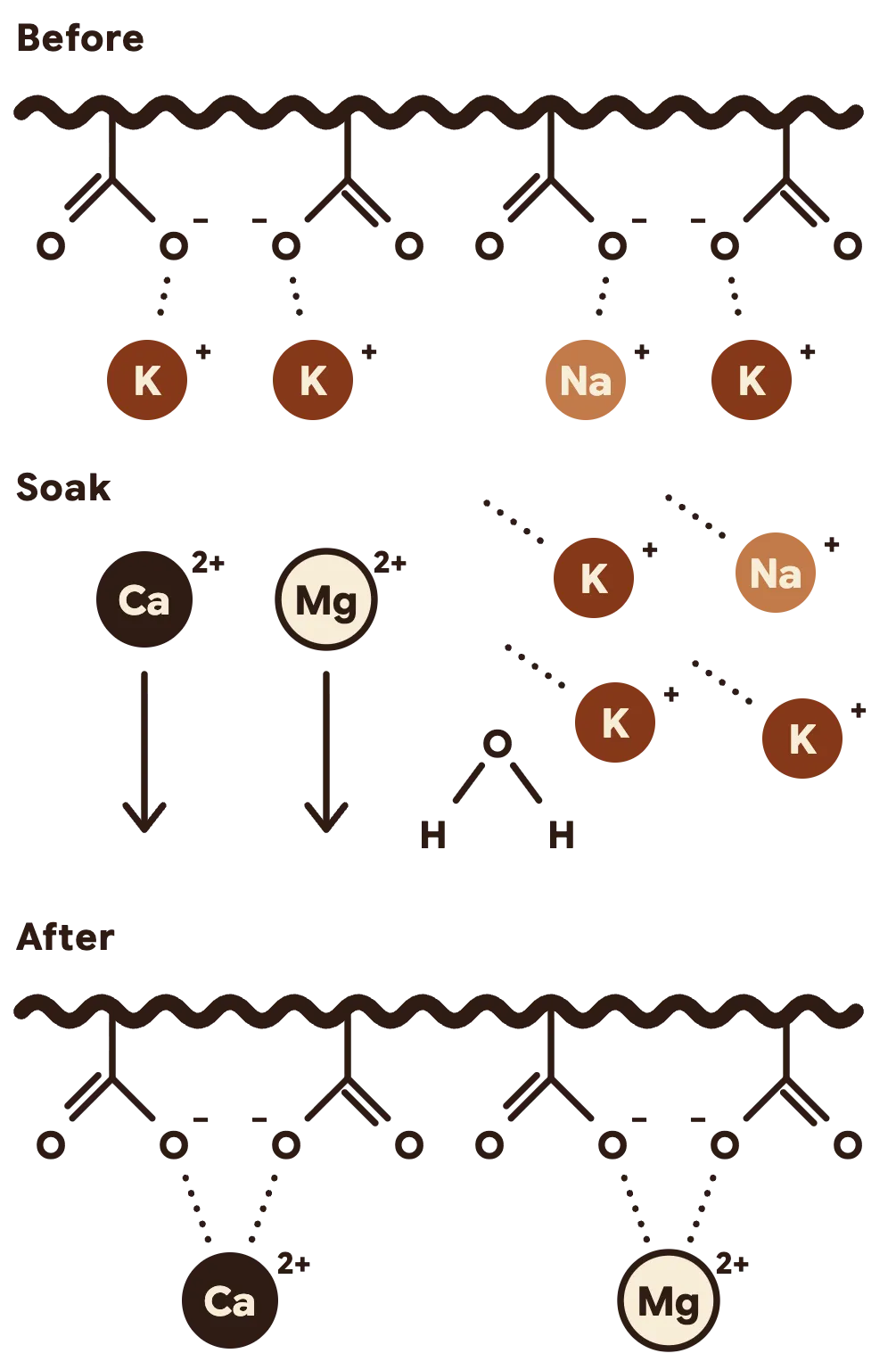
Without that step, the medium competes with your fertilizer. You feed calcium and magnesium, the sites take them, and potassium and sodium come back out in trade. The plant receives less than you dosed plus potassium it did not ask for. RHP reports untreated coir pith releasing up to 20 mmol/L of potassium into the culture. Adding more cal-mag does not fix this quickly, because the unbuffered coir intercepts that too.
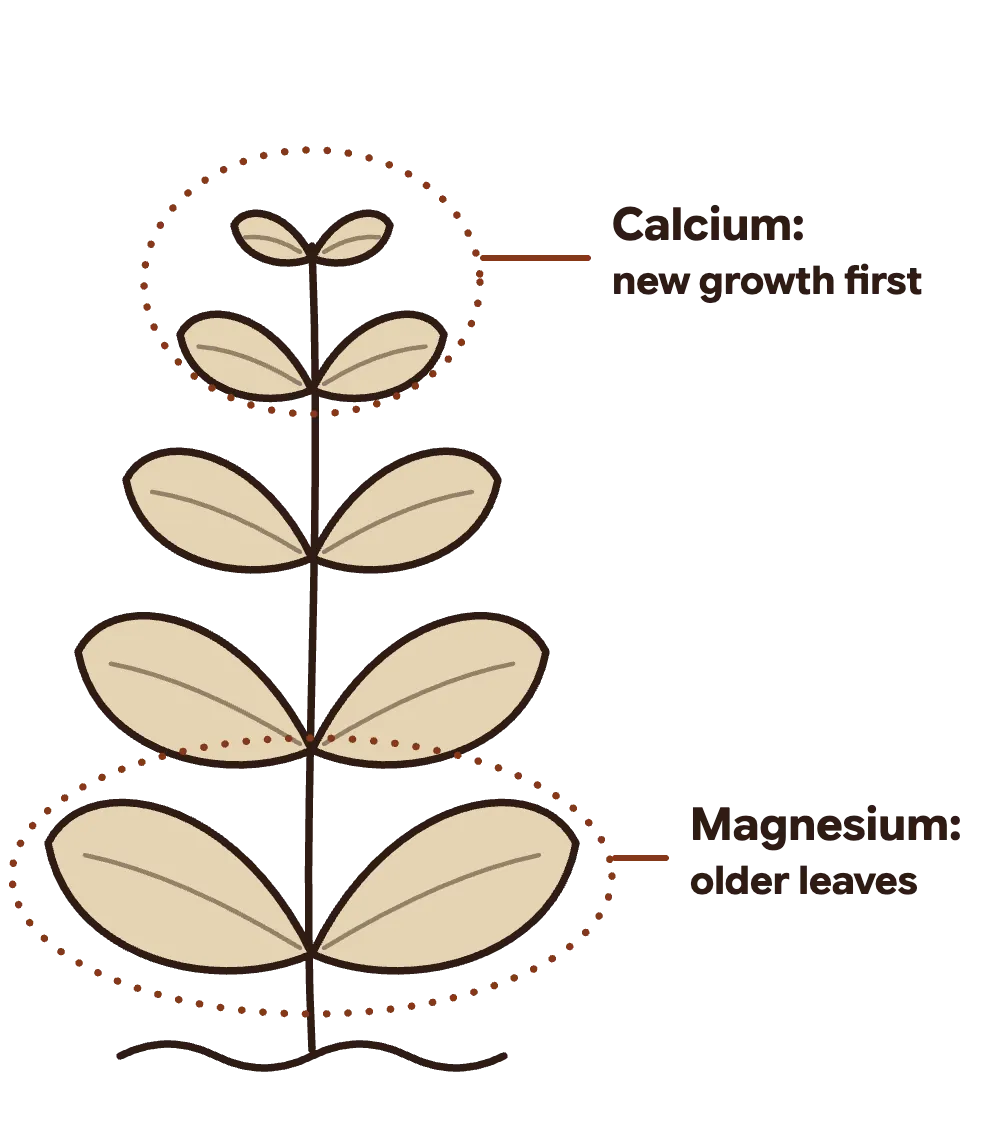
The symptoms read as calcium deficiency, and they show on new growth first because calcium is immobile in the plant: distorted or hooked new leaves, crispy margins, tip burn, blossom end rot in fruiting crops, tipburn in lettuce. Magnesium is mobile, so magnesium deficiency appears on older leaves instead, as yellowing between the veins.
Worth adding, because it is the clearest finding in the actual literature and the one the category talks about least: coir's properties vary significantly between sources and even within them. Both Abad's 2002 survey and Evans and colleagues in 1996 found this. The problem coir presents is not that it is bad. It is that it is inconsistent, and processing is what makes it predictable.
How buffering is done
The full commercial chain runs: de-husking, retting, separating pith from fiber, aging or composting for anywhere from 6 to 18 months, washing, buffering, a final rinse, drying, then grinding, grading, and compression into blocks.
- 1De-husking
- 2Retting
- 3Separating pith from fiber
- 4Aging or composting6 to 18 months
- 5Washing
- 6Buffering
- 7A final rinse
- 8Drying
- 9Grinding, grading, and compression
The buffering step uses calcium nitrate as the standard agent, sometimes with magnesium alongside it. Published and trade descriptions converge on 24 to 48 hours of contact time.
The part most discussions skip is the rinse afterward. The displaced potassium and sodium have to be flushed out along with any unbound calcium, or what you have made is simply high-EC coir. Buffering without the rinse-out solves nothing.
Be careful which targets you believe
The figures that circulate as the RHP standard, under 1 mmol/L sodium and under 2 mmol/L potassium with EC under 0.6, do not appear anywhere on RHP's public site. They trace back to a single manufacturer citing RHP, and the real specification sits behind member documentation. Widely cited is a fair description of them. Established is not.
There is also a measurement problem the category rarely mentions. An EC figure means very little without the extraction method behind it. RHP's own strawberry guidance specifies the 1:1.5 volume extract and advises starting at 0.75 mS/cm in that extract. Almost none of the guidance written for home gardeners says which method produced its number, which is precisely why EC figures quoted across different brands are not comparable with each other.
Buffering coir yourself
You can do this at home, and it is worth understanding even if you buy coir with the step already done.
Hydrate the coir fully with clean, warm water and break it apart so the water reaches all of it. Rinse with clean water until the runoff EC trends down toward your source water. Then soak it in a calcium and magnesium solution. A commonly used home ratio is roughly 14 grams of calcium nitrate and 4 grams of Epsom salt per 5 gallons of water, left for somewhere between 8 and 24 hours, toward the longer end for anything you plan to start seeds in. Drain the solution, give it a final light rinse, and let it drain to a workable moisture.
It works, and plenty of gardeners do it every season. It also takes a day, some space, several buckets, and a couple of attempts before you get a feel for it. We do the step before the coir is pressed into a brick, so what arrives at your door only needs water.
What buffering does not do
It is not a feed
Pelemix puts this well: the goal of buffering is not to correct a defect but to optimize the chemical properties of the coir. Coir is nutritionally close to inert, and Abad's samples were low in available nitrogen, calcium, magnesium, and micronutrients. Buffered coir still wants feeding on your usual routine.
It does not replace cal-mag, though not for the usual reason
Buffering stops the medium from intercepting the calcium and magnesium you supply. It does not supply the plant's ongoing demand for them. On RO or soft water there is no calcium or magnesium in the water either. Whether you need a separate cal-mag product comes down to your base fertilizer and your water, not to whether the coir was buffered. Cal-mag sellers say always and buffered-coir sellers imply never, and neither of those is honest.
It does not wear off in a dry bag
There is a persistent forum claim that buffered coir has to stay moist to hold its charge, and that dry compressed products cannot genuinely be pre-buffered. Nothing authoritative supports it and it contradicts the entire dry-block market. Bound calcium is not going anywhere in a dry brick. During a grow is a different question: a high-potassium feed will gradually re-load the sites, which is why reused coir is generally worth re-buffering.
And the word itself is not always reliable
Two unrelated things get called buffered. One is the ion exchange described on this page. The other is simple pH adjustment, bringing the medium into roughly 5.5 to 6.8. Some labels mean the first, some mean the second, and some do both and say so clearly: Mother Earth's copy, for instance, separates them properly by saying pre-buffered and pH adjusted. Others blur them entirely. Two bags both reading buffered are not necessarily making the same claim, so the label is worth a second look.
Sources
- Abad, M., Noguera, P., Puchades, R., Maquieira, A. and Noguera, V. (2002). Physico-chemical and chemical properties of some coconut coir dusts for use as a peat substitute for containerised ornamental plants. Bioresource Technology 82, 241 to 245.
- Evans, M.R., Konduru, S. and Stamps, R.H. (1996). Source variation in physical and chemical properties of coconut coir dust. HortScience 31(6), 965 to 967.
- van Dam, J.E.G. Coir Processing Technologies. Technical Paper No. 6, Common Fund for Commodities and the Food and Agriculture Organization of the United Nations.
- RHP (2017). Focus on nutritional elements: potassium.
- RHP (2017). RHP advice coir substrate for strawberries.
- Pelemix. Buffered Coco: The invisible ally for a perfect crop start.
- Prestige Impex (2022). The science of buffering coco coir. The before-and-after figures quoted under Rinsed is not the same as buffered.
- Hawthorne Gardening Company. Mother Earth Coco, product page.
Which of ours are buffered
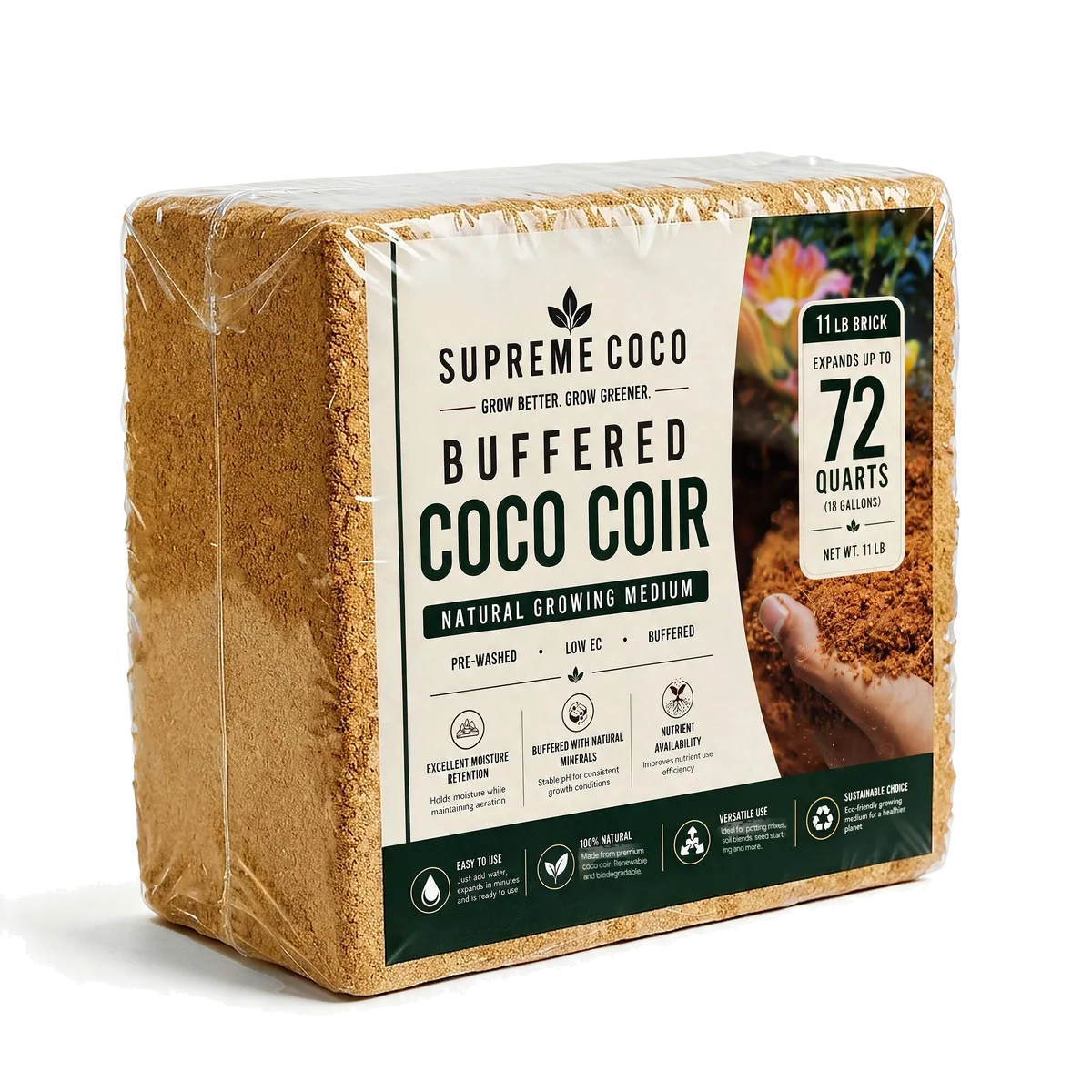
Coco Coir Brick
Buffered. Soaked before it is pressed, so excess salts wash away and the pH settles into balance.
See the details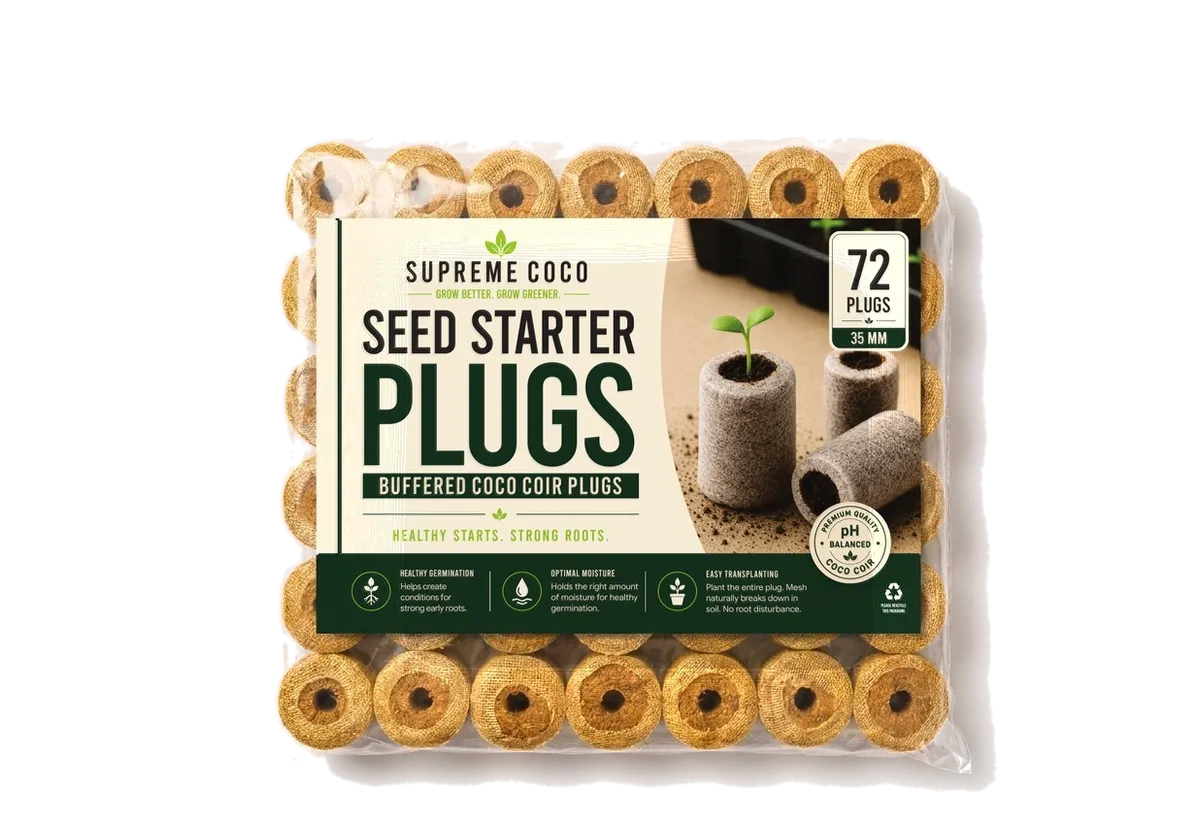
Seed Starter Plugs
Buffered. The same step, done before the coir is formed into plugs.
See the details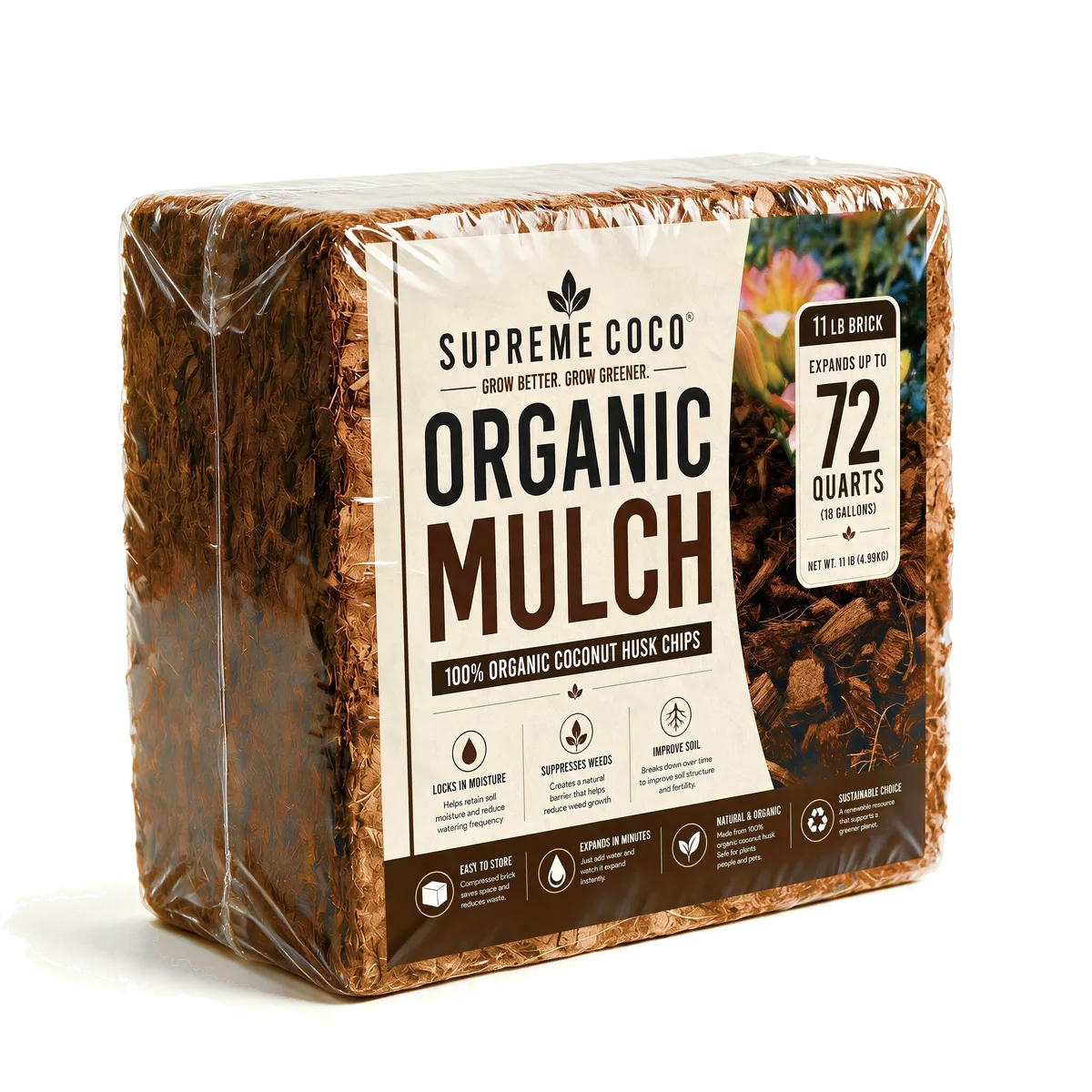
Organic Mulch
Not buffered, and it does not need to be. These are coconut husk chips for the surface, not the mix your roots grow in.
See the detailsCommon questions
Why does coco coir need buffering?
Fresh coco coir carries natural salts. Some come from the husk itself and some from the water used to process it. Those salts sit in the same spots your plants look for calcium and magnesium, so they can get in the way. Buffering soaks the coir until the excess washes out and the pH settles into balance, which gives roots a cleaner start.
Is buffered the same as rinsed or washed?
No. Washing rinses away the loose salts. Buffering goes a step further and changes what the coir itself is holding on to, so coir can be washed and still not be buffered.
Which Supreme Coco products are buffered?
The Coco Coir Brick and the Seed Starter Plugs are both buffered. The Organic Mulch is not, and it does not need to be. Those are chunky coconut husk chips rather than the fine coir in the brick, so buffering would not change how they work.
Does buffered mean the same thing on every bag?
Not always, so it is worth reading the label. Some brands use buffered to mean the coir was soaked to swap out excess salts. Others use it to mean the pH was adjusted. Those are two different things, so two bags that both say buffered are not always making the same promise.
Can I buffer coco coir myself?
You can. Gardeners rinse unbuffered coir well, soak it in water mixed with a calcium and magnesium feed, then drain it and rinse it through again. It works, and plenty of people do it. It also takes a day, some space, and a few buckets. Ours is buffered before it ships, so yours only needs water.